Nature Scientific Reports · 2024
Strategic Behavior of Large Language Models and the Role of Game Structure versus Contextual Framing
Do LLMs reason strategically, or just react to framing? Both — and the mix depends on the model.
Nunzio Lorè, Babak Heydari
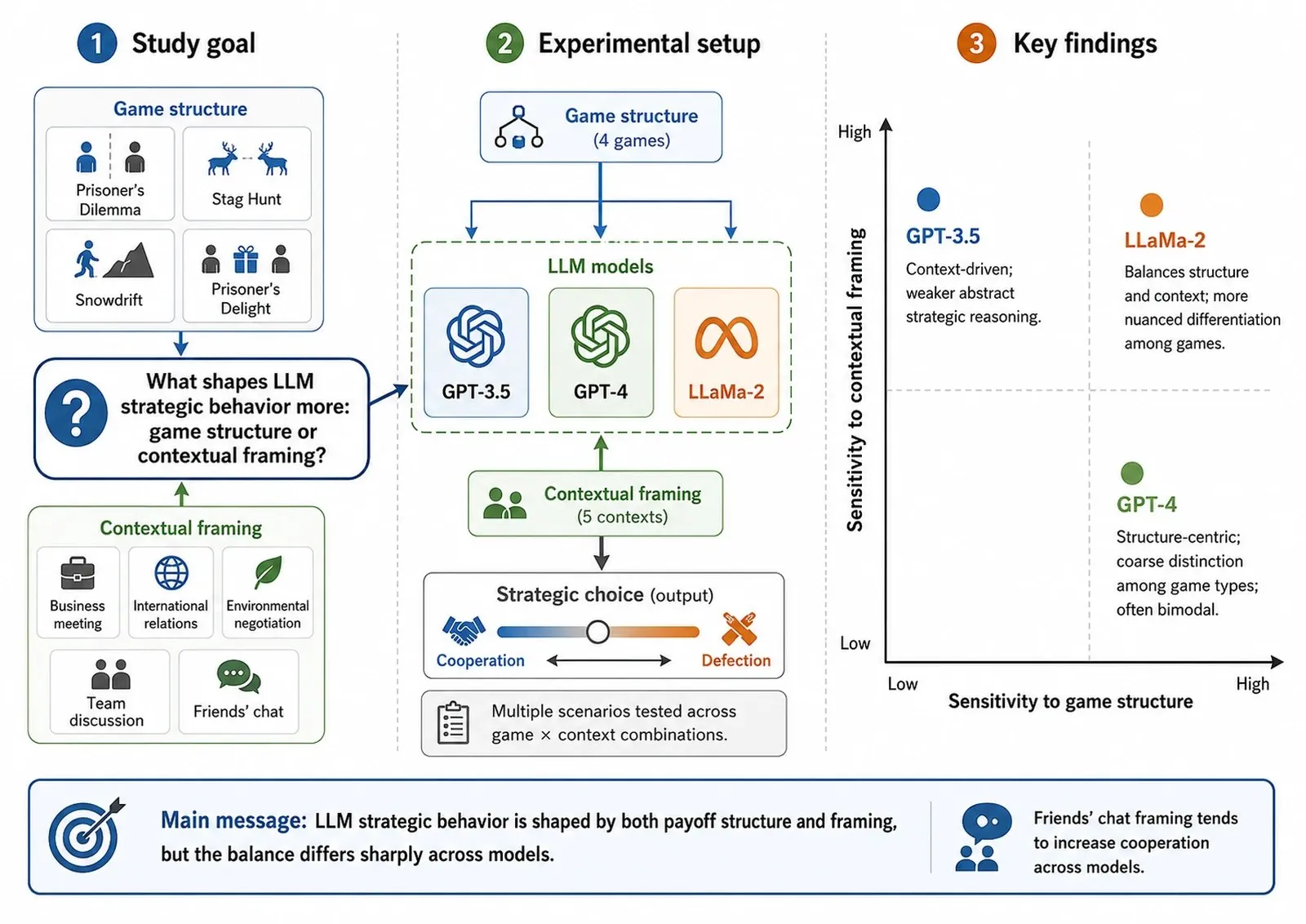
Do large language models actually reason strategically, or do they just respond to surface framing? Across four canonical two-player games (Prisoner’s Dilemma, Stag Hunt, Snowdrift, Harmony) and five framings (business, diplomacy, environment, teammates, friends), three models behave differently:
- GPT-3.5 follows context and largely ignores game structure.
- GPT-4 mostly tracks structure but collapses the four games into a binary cooperate-or-defect choice.
- LLaMa-2 distinguishes the games more finely while still being moved by framing.
No model fully escapes the influence of how a situation is described — a finding with direct implications for deploying LLMs as strategic agents.