Strategic Management Journal · 2026
Core or Periphery: Examining Where to Allocate Heterogeneous Inventors and the Impact on Firms' Innovation
Where heterogeneous inventors sit in a firm's network changes what the firm can discover.
Babak Heydari, Shinjinee Chattopadhyay, Soumyakant Padhee, Samina Karim
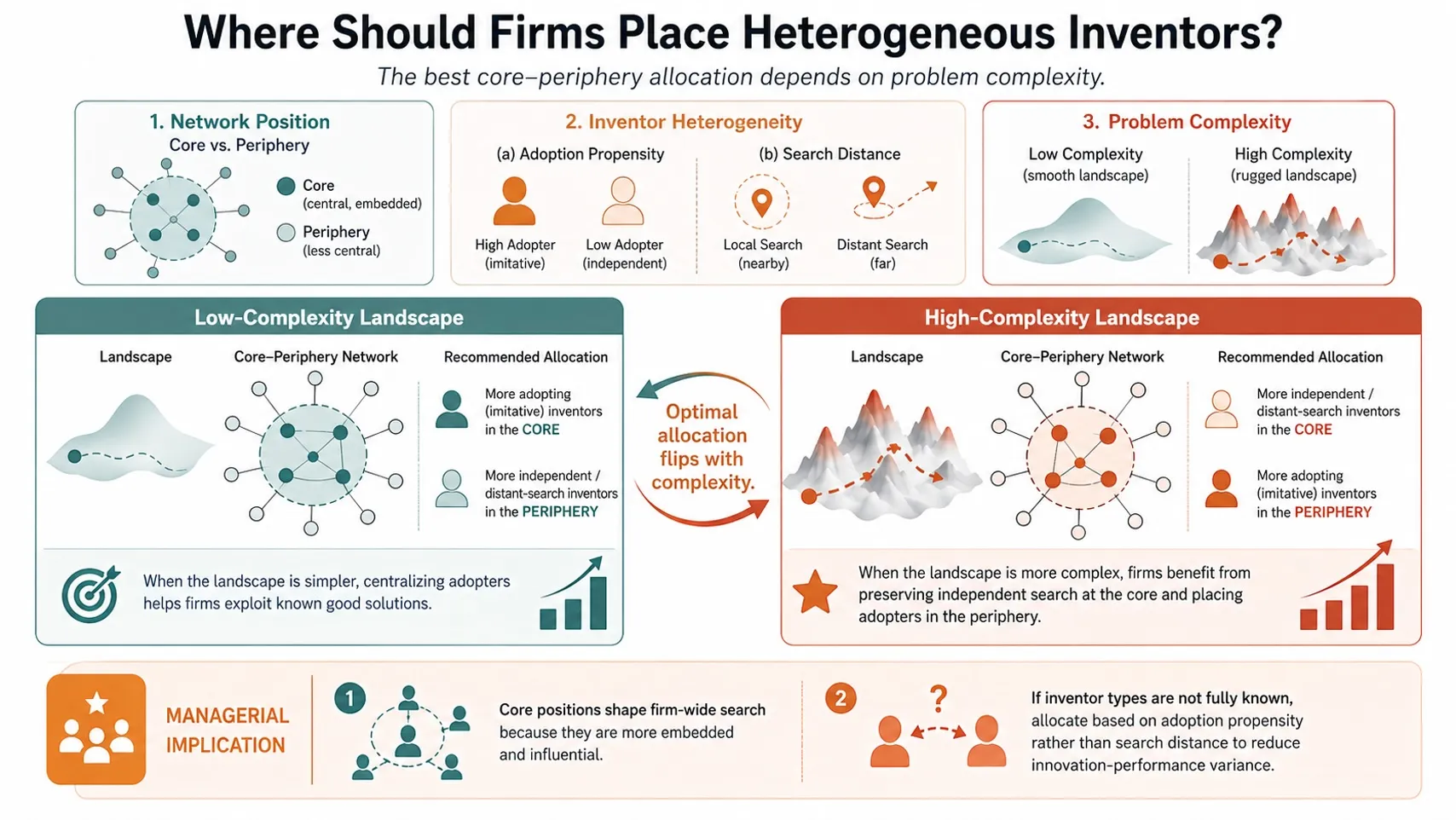
Where in a firm’s internal network should different kinds of inventors sit to maximize innovation? Using an NK model that captures network embeddedness, individual heterogeneity (search distance and imitation propensity), and landscape complexity, the paper shows that in high-complexity environments firms benefit from placing low-imitators at the core and high-imitators at the periphery — promoting independent search where the structure most amplifies it.
The pattern flips under low complexity, and when individual types are unknown, adoption propensity turns out to be a more useful sorting signal than search distance.