ASME Journal of Mechanical Design, 148(4): 041708 · 2026
Adaptive Information Modulation: Designing Governance Mechanisms for Multi-Agent Artificial Intelligence Systems
Govern a multi-agent LLM system by modulating what each agent sees — not who it talks to.
Qiliang Chen, Sepehr Ilami, Nunzio Lorè, Babak Heydari
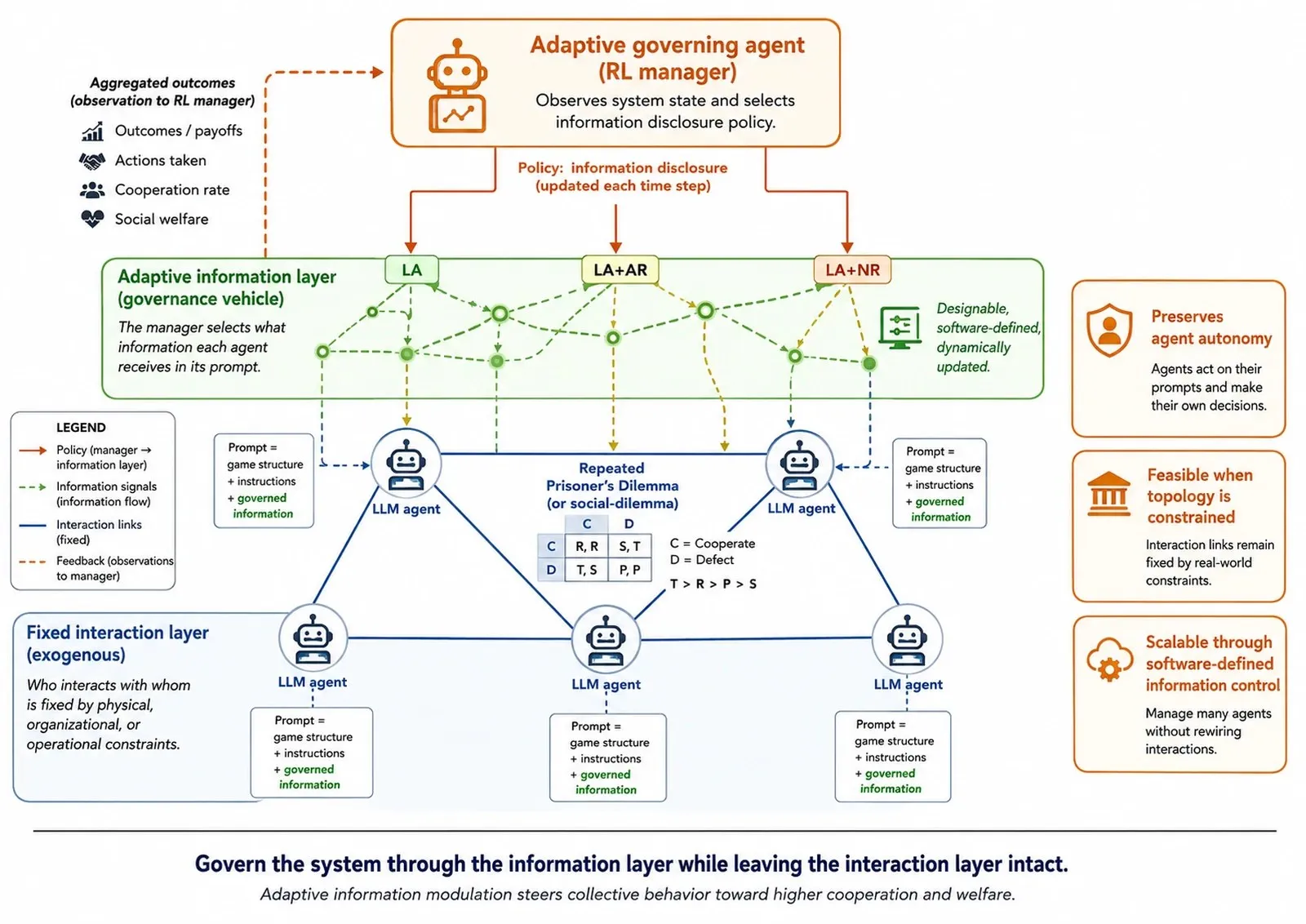
How do you steer a multi-agent system of LLM-based agents toward cooperative outcomes when you can’t rewire who talks to whom? This paper introduces a governance framework that separates the fixed interaction layer — who interacts with whom, set by physical or organizational constraints — from a software-defined information layer that a reinforcement-learning manager dynamically modulates.
The manager observes aggregated outcomes (payoffs, cooperation rate, social welfare) and, each time step, chooses an information-disclosure policy that decides what each agent receives in its prompt. Agent autonomy is preserved — they still decide what to do — but the strategic landscape they perceive shifts. Across repeated social-dilemma settings with several LLM agents, adaptive information modulation steers collective behavior toward higher cooperation and welfare, and scales without rewiring the interaction graph.